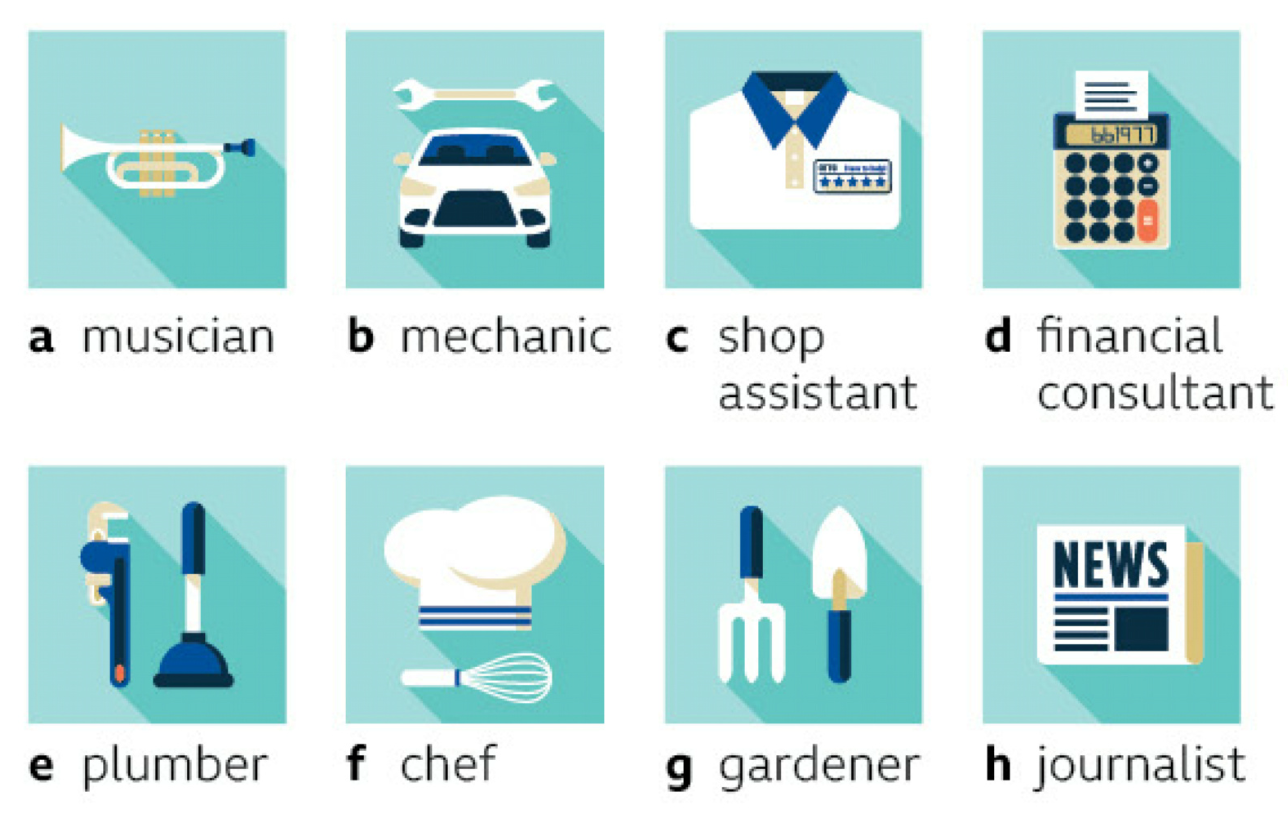
1A Write down five jobs that involve helping other people. Medical workers save lives. Teachers help us to learn. 1B Work in pairs. Compare your ideas. Then decide which jobs help people the most.
2A
Listen to eight people talking about their jobs. Match the speakers with the jobs (a-h).
1.04
1
2
3
4
5
6
7
8
C Work in pairs. Discuss the questions. How can you describe the jobs in Ex 2A? Which would you like to do? Why? A chef is responsible for planning the menu and creating new dishes.
I'd like to be a financial consultant because they earn a good salary.
VOCABULARY BANK
1B work page 136
Complete what the people say about their jobs with the words in the boxes.
careerpart-timewages
'I'm a student, but I have a 1 job in a supermarket. I work every Saturday and Sunday. I'm studying finance and I'd like a 2 as a banker one day. I think it's an interesting job and the 3 are good. I can make a lot of money.'
full-timeresponsible forrun
'I 4 a small company that makes furniture. I'm 5 the designs and for finding customers. It's a 6 job. Sometimes I work fourteen hours a day when we're busy.'
out of workprofessionqualificationsvolunteer
'I'm a singer. Unfortunately, I'm 7 at the moment. Singing is a very difficult 8 because there are loads of singers and a lot of competition. I have no 9 because I never did well in exams and I left school when I was fifteen. When I'm not singing, I 10 at a shelter for homeless people. We aren't paid, but I love helping others.'
VB1.02
PRONUNCIATION
syllable stress
3
3A Which syllable is stressed in these words? Which word has a different stress pattern?
assistant consultant journalist mechanic musician
1.05
3B Listen and check. Is this statement true or false?
"The stress on three-syllable jobs is usually on the second syllable."
True/False
3C Make sentences about the jobs in Ex 3A, then read your sentences to a partner. Remember to stress the correct syllable. My brother is a journalist.
READING
4A Read the three texts about people who help others. Complete the table with information from the texts.
Food is Free
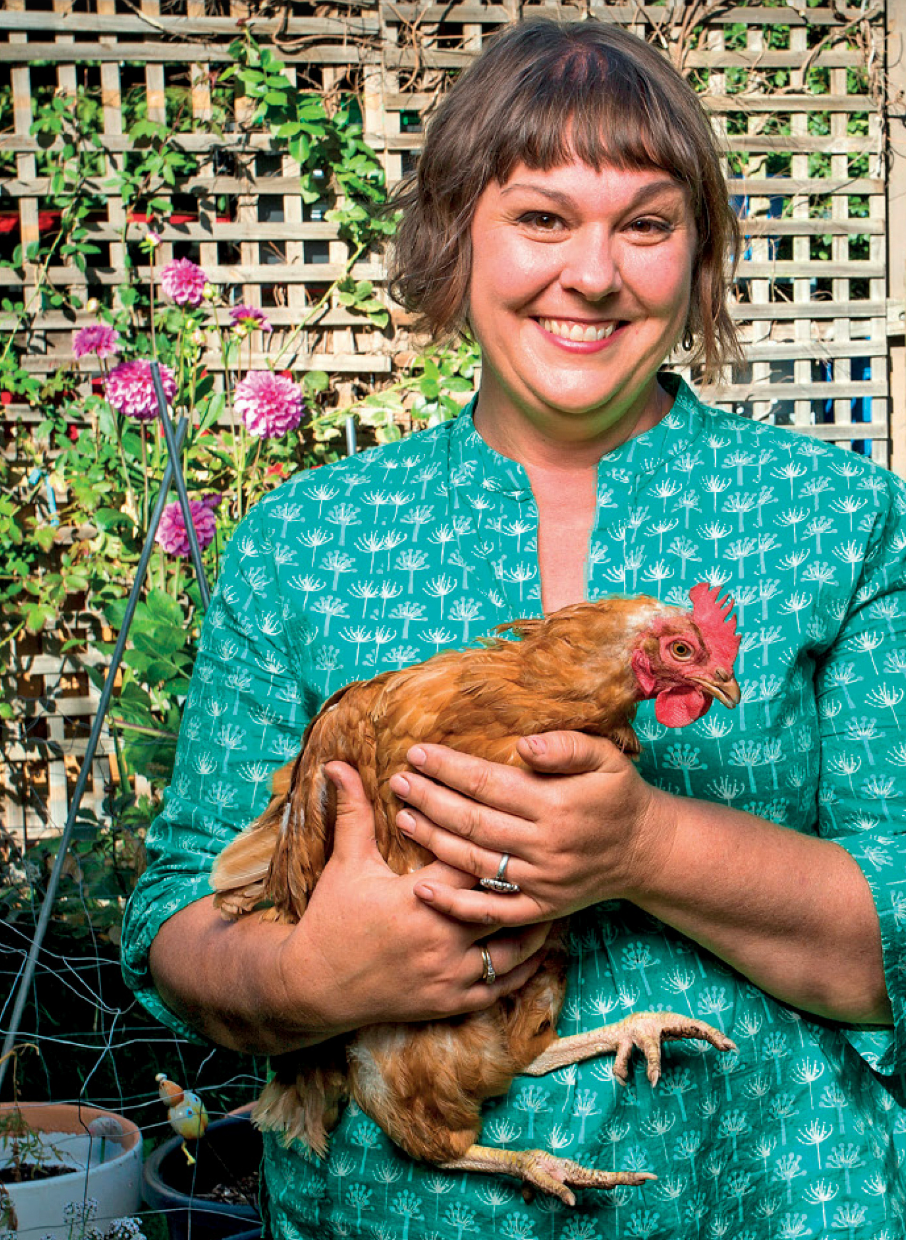
Lou Ridsdale loves gardening. In a small space next to her home in Ballarat, Australia, she grows vegetables. One day, she heard about a man in Los Angeles who grew food to share with the community. He belonged to an organisation called Food is Free. Ridsdale saw that she had more vegetables than she needed and decided to give these away, like the man in Los Angeles.
After that, she set up the food stall outside her house. She put up a sign saying people could help themselves. Soon restaurants were bringing food for those in need. People usually bring fruit and vegetables but sometimes hot food, seeds and even clothes. There is no money involved, no food is sold for money. No one is judged on what they bring or take - they just come, as long as they leave with a smile. She makes sure they always do.
Apart from feeding people, Ridsdale understands that education is the other important part of the programme. Once the programme was established, she began to go into schools to talk about food. She believes that young people need to learn about healthy eating. This will help to make their lives healthier and better. She hopes to see her idea catch on all over Australia.
The Kind Stranger
Zeal Akarawai is a financial consultant from Lagos, Nigeria. He works hard and earns a good salary, but what makes him special is what he does with his money. After visiting a hospital one day, he saw patients who couldn't afford to pay their medical bills. He decided to help by paying strangers' bills.
Zeal doesn't belong to any organisation. He simply goes to hospitals and offers to pay for people who are in need. He is kind and caring, and he believes that everyone deserves good healthcare. When he pays a bill, he doesn't want to receive anything in return. He just asks the patients to tell people what happened - that an unknown person paid their bill. He hopes to see more people helping each other.
The Plumber Who Cares
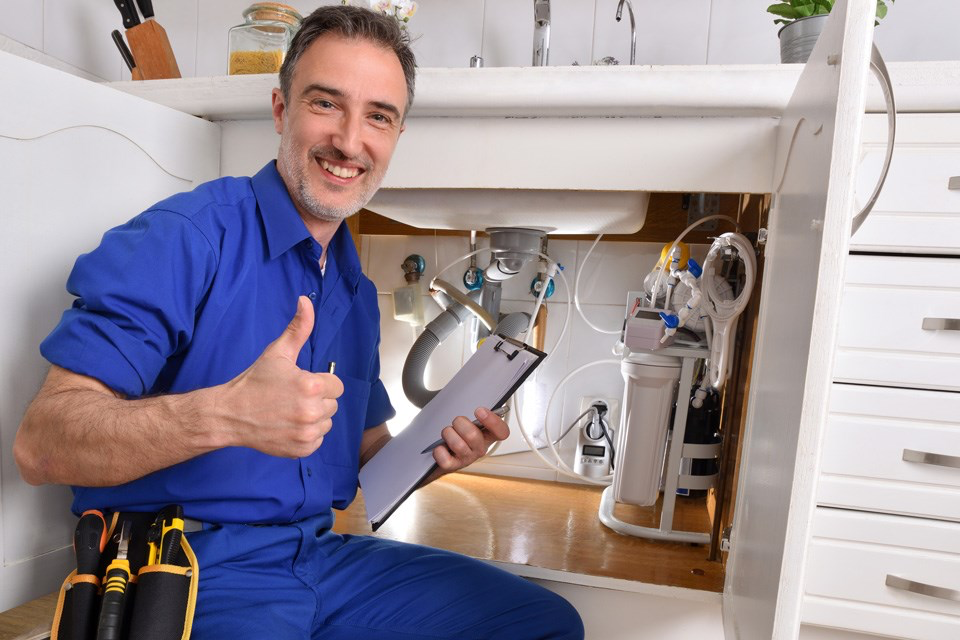
James Anderson lives in Burnley, in the north of England. He is a plumber, and he started to do free plumbing for older people and people with disabilities. In winter, when heating systems break down, older people really need to borrow money to pay for repairs, and many of them don't have a lot of income.
James decided to start a company that does free plumbing. He noticed that many older people don't like to ask for help because they feel embarrassed. He wants to make it easier for them. Many people don't have a lot of income and don't like asking for help. James agreed to work for free because he believes in kindness. He hopes his kindness will catch on.
4B
Complete the table with information from your text.
Text A
Text B
Text C
Who is the text about? Where?
What is their job? What do they do for other people?
Why do they do it?
Do they run an organisation?
What do they say about what they do?
5C
Find words or phrases in bold in your text to match the meanings (1-5).
1 a document showing how much you have to pay
2 behaviour that shows you care for and want to help others
3 the money that someone earns or receives regularly
4 to do something so you can be certain of the result
5 to become popular
FUTURE SKILLS | Social responsibility
The texts often describe people like Lou, Zeal and James as good people or heroes. Define a good person. Are the people in the texts good people? Which famous people do you think are good? Why?
GRAMMAR
verb patterns
6A Look at the highlighted verbs in your text. Find...
1 an -ing form as the subject of a sentence2 a preposition + -ing form3 a verb + to + infinitive4 a verb + -ing form
6B
Correct the mistakes in the sentences. One sentence is correct.
1 After leaving school, I decided for do a plumbing course.
to do/for do/doing
2 She hopes for become a chef.
to/for/of
3 You need to speaking to a financial consultant.
speak/speaking/spoke
4 Working here is great - I love meeting new people.
correct/to meet
5 Before study to be a doctor, he worked as a volunteer in a hospital.
studying/study/to study
GRAMMAR BANK
1B verb patterns page 105
Verb patterns
1
Complete the sentences with the -ing or to + infinitive form of the verbs in the box.
drinkfinishgohaveliveplayrepairswimvisit
1 The mechanic helped ______ my car.
2 I need ______ a meeting with a financial consultant.
3 Would you like ______ out for dinner tonight?
4 I can't imagine ______ in that house - it's so small!
5 I don't like ______ water from a bottle.
6 They decided ______ football this morning.
7 Do you enjoy ______ in the sea?
8 I hope ______ my degree this year.
9 I love ______ books about adventures.
10 They want ______ the monuments tomorrow.
2
Complete the text with the correct -ing or to infinitive form of the verbs in brackets.
Helping me choose
When I was ten, I wanted 1(be) a pilot. I hoped 2(fly) all over the world. But when I turned eleven, everything changed because I met Mrs Jones, a teacher at my secondary school. She was the best! I enjoyed 3(learn) with Mrs Jones because everything we did was fun. Before 4(attend) her class, I hated science, but I stopped 5(hate) it because of her. We spent lots of time 6(do) fun things. She took us outside to learn about nature and she also took us to amazing museums. She seemed 7(love) teaching and she was very kind to us. 8(learn) became fun. After 9(study) with her for a year, I decided 10(become) a teacher myself. Ten years later, I was standing in front of my own class!
SPEAKING
7
Choose one of the headlines and invent a news story. Answer the questions (1-5) to help you.
100-year-old walks his dog and raises $1,000,000 for hospital
Woman plants a tree every day for a year
Recycling hero builds parks for kids
Use these phrases: after + -ing, agree to, before + -ing, decide to, begin to, help to, need to, want to
1. Where and when did it happen? 2. Who was involved? 3. Why did they decide to do this? 4. What difficulties did they have? 5. How did people hear about the story?
Lesson 1B - Good people - Results
Exercises
Ex 2A
-
VB work
-
Pron
-
Ex 5C
-
Ex 6B
-
GB 1
-
GB 2
-
Speaking
-
Total
-
HOW TO... start/end a conversationVOCABULARY: conversation topicsPRONUNCIATION: rhythm and intonation
VOCABULARY
conversation topics
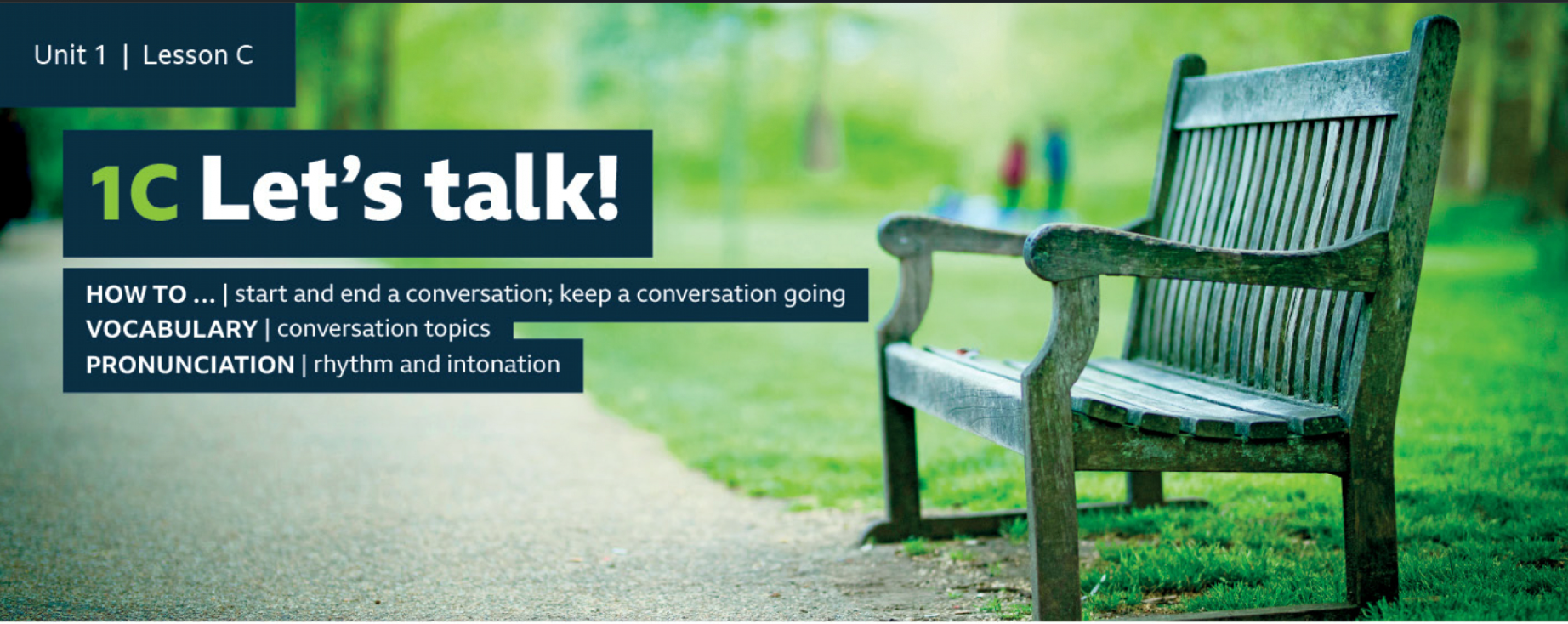
1A Look at the photo. What do you think a 'Happy to chat bench' is? Who do you think might use it?
1B Read the text to check your ideas.
The benefits of talking to strangers
Most of us spend part of our day surrounded by strangers, perhaps when travelling to work, sitting in a park or a cafe or visiting the supermarket. We are together with other people, but nobody talks. However, research shows that starting up a conversation with a stranger can make you feel happier and enjoy your day more.
When Allison Owen-Jones sat a man sitting alone on a bench in the park, she wanted to talk to him, but she felt uncomfortable because she wasn't sure he would want to chat. Then she had an idea: 'Happy to chat benches!' She made a sign to put on park benches which said, 'Happy to chat bench. Sit here if you don't mind someone stopping to say hello.' The idea was a success. Now 'Happy to chat benches' can be found in several countries including Canada, the USA, Australia, Switzerland and Ukraine.
So, the next time you see someone sitting alone, give them a smile and say hello. You never know - they might be happy to talk.
1C Work in pairs. Answer the questions.
1 How often do you talk to people you don't know? In what places?
2 Do you think 'Happy to chat benches' would be a good idea where you live?
3 Which topics do you think are suitable or not suitable for talking to people you don't know?
2A
Match the questions for starting a conversation (1-9) with the topics in the box.
clothes and fashionfood and eating outhobbies and free-time activitiesholiday experiencespoliticssport or music eventsthe newsthe weatherwork or studies
1 Did you hear about the fire in town? It's terrible.
2 That's a nice jacket. Where did you get it?
3 Lovely day, isn't it?
4 So, who do you think will win the election?
5 A friend tells me you like painting. What kinds of things do you paint?
6 It's the Big Music Live this weekend. Are you going?
7 I hear you have a job in finance. Do you enjoy it?
8 Have you tried these pastries? They look delicious.
9 We've just got back from Corfu. It was wonderful.
HOW TO...
start and end a conversation; keep a conversation going
3A Listen to three conversations. Where are the people? What topics do they talk about? Make notes.
1.06
3B
Are the statements True (T) or False (F)? Listen again to check.
Conversation 1
1 The man has never been to the music festival before.
True/False
2 The woman is going to see a family member at the festival.
True/False
Conversation 2
3 Kate prefers the coffee from the coffee machine.
True/False
4 Kate started work two weeks ago.
True/False
Conversation 3
5 The man is on holiday.
True/False
6 The woman likes the city.
True/False
4A
Complete the extracts from the conversations with the missing words.
1.07
Conversation 1
Woman: Excuse me, 1 sitting here?
Man: No, go 2.
Woman: Thanks.
Man: No 3.
Woman: Are you going to the music festival?
Man: Yes, I go every year. How 4 you?
Conversation 2
Kate: I'm Kate, by the 5.
Justine: Hi Kate. I'm Justine.
Kate: Great. Well, Justine, I've 6 go. Nice to 7 you.
Justine: Yes, nice to meet you, too.
Conversation 3
Man: Excuse me, do 8 if I charge my phone here?
Woman: Not at all. 9 my guest.
Man: Thanks. That's very kind.
Woman: Oh, that's my train. Nice 10 to you.
Man: Safe journey home!
5A
Match the sentences (1-8) with their uses. Drag words to the correct column.
Nice talking to you.Do you mind if I charge my phone here?Help yourself.I've got to go.Is anyone sitting here?Do you know if there's a cafe near here?What about you?Nice to meet you.
Starting a conversation
Responding / keeping going
Ending a conversation
GRAMMAR BANK
1C How to... start and end a conversation page 106
How to... start and end a conversation; keep a conversation going
Starting a conversation with a stranger
Excuse me, is anyone (sitting here/using this)? Is this your first time (here/at this event)? Do you mind if I/Is it OK if I (charge my phone)? How long have you (had your dog/lived here)? Are you going (to London/to the festival)?
I'm (name), by the way.
Starting with a friend/acquaintance
It's a lovely (morning/day), isn't it? Did you hear about (the earthquake)? Did you watch (that programme)? Are you doing anything nice (at the weekend)? How was your (weekend/holiday)?
Responding and keeping going
No problem. / Go ahead. / Not at all. Help yourself. / Be my guest. What about you? / How about you? / And you?
Ending a conversation
OK, nice to meet you. / See you later.
(Great/Nice) talking to you. Have fun. / Have a good time. I've got to go. / That's my (bus/train).
1
Choose the correct word(s) to complete the conversations.
1 A: Excuse/Excuse me, is anyone sitting here? B: No, go ahead/go on.
2 A: Do you mind that/if I charge my phone here? B: No/Is no problem.
3 A: Is this the/your first time here? B: Yes, what for/about you?
4 A: How long have you lived/do you live here? B: Two years. And/And for you?
5 A: Are you going in/to Cambridge? B: Yes. Sorry, I've got to/I don't go.
6 A: Are/Do you mind if I sit here? B: You are my/Be my guest.
7 A: I'm Jess, on the/by the way. B: OK, nice that I meet/nice to meet you, Jess.
8 A: This is/This my bus. B: OK, enjoy/enjoying your weekend.
2
Put the words in the correct order to make sentences.
1 you / talking / to / nice .
2 nice / weekend / you / at / anything / the / doing / are ?
3 anyone / is / this / using ?
4 time / a / good / have .
5 if / you / charge / mind / I / phone / here / do / my ?
6 to / OK / you / meet / nice .
7 train / this / my / is .
8 later / you / see .
3
Complete the conversation with the phrases (a-f).
a - Have funb - It's a lovely morning, isn't it?c - How about you?d - No problem.e - How was your weekend?f - I've got to go.
Paulo: Oh, Hi Mel. 1
Mel: Yes, it's beautiful! 2
Paulo: It was OK, thanks. I didn't do much but it was nice to relax. 3
Mel: I went out with Josie on Saturday. That was fun.
Paulo: Where did you go? Oh! This is my bus. 4
Mel:5
Paulo: See you later.
Mel:6 at work today.
Paulo: I'll try!
PRONUNCIATION
rhythm and intonation
6A Listen to the phrases we use for responses. Notice that they all follow a similar rhythm and intonation pattern. Not at all. Go ahead. Help yourself. Be my guest. No problem.
1.08
6B Do the phrases follow the same or a different pattern? See you later. Nice to meet you. I've got to go. Enjoy your weekend.
1.09
SPEAKING
FUTURE SKILLS | Communication
To keep a conversation going, it is important to listen actively and show you are interested in what the other person says. Ask questions like 'How about you?' or other questions that encourage the other person to talk.
7
You are sitting on a 'Happy to chat bench' near the station. Think about where you are and why you are sitting there. Someone comes to the bench to talk to you. Start a conversation.